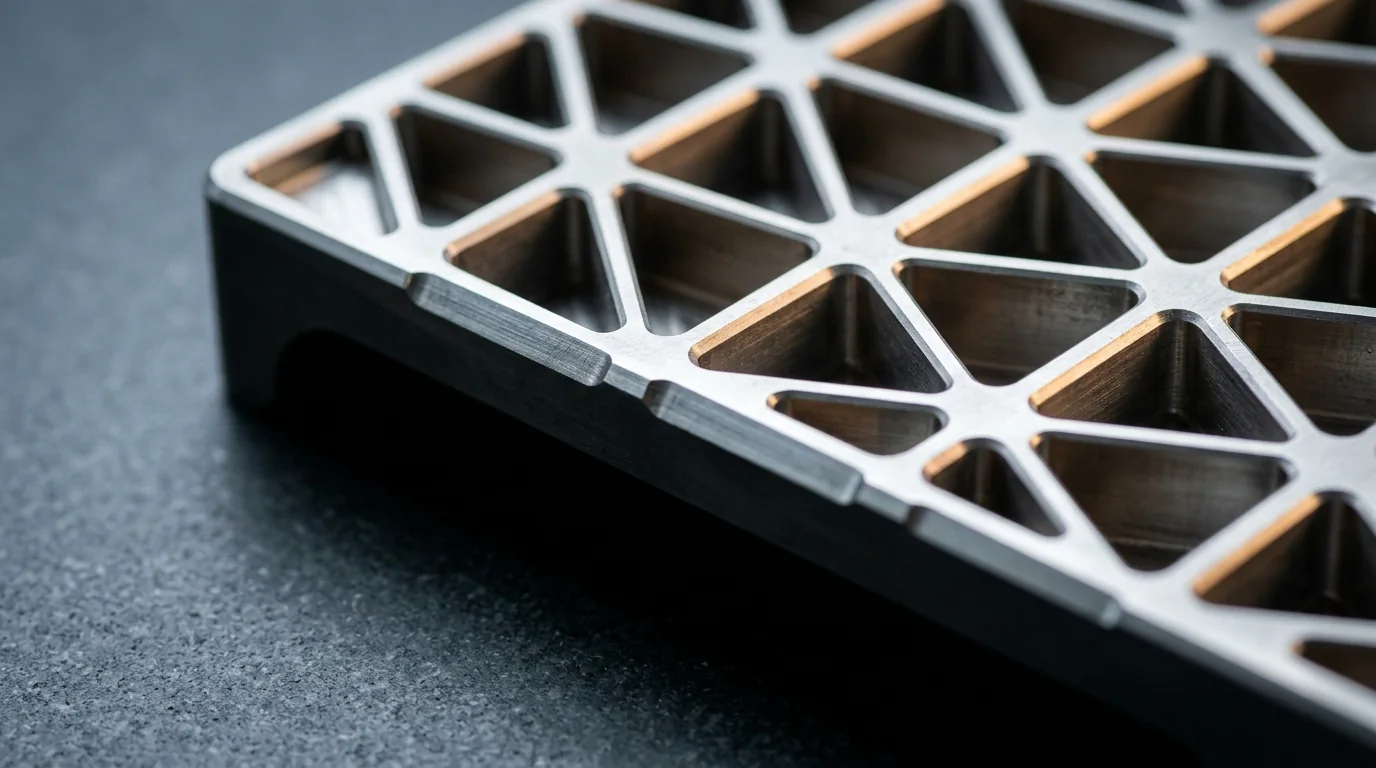
Solving Residual Stress Distortion in Monolithic Forgings
Removing more than 88% of mass from a solid aerospace titanium forging inevitably releases locked-in internal stresses. Conventional single-setup machining approaches struggle with rib twisting once wall thicknesses drop below 1.2 mm.
VEKTOR’s Munich aerospace engineering team instituted a three-stage symmetric stock-removal sequence paired with controlled vacuum stress relief and vacuum-chuck zero-clamping prior to final finish passes. Rather than forcing thin ribs flat under mechanical toe clamps, parts rest in a stress-free state throughout finish contouring.
Closed-Loop Probing and Digital Twin CMM Overlay
Before final bore interpolation, spindle-mounted infrared probes map thermal drift across the workpiece and dynamically update zero-point offsets. Completed bulkheads transition directly into our 20.0 °C bridge CMM bay, where continuous tactile scanning verifies 1,400+ profile points against the master STEP solid.
Across 120 consecutive production units (illustrative engineering benchmark), critical datum bores sustained a Cpk of 1.84 with zero rework dispositions.